I don’t think I’ve ever felt a film really know the feeling of the late 90s/early 2000s in the way that Jane Schoenbrun’s I Saw the TV Glow does.
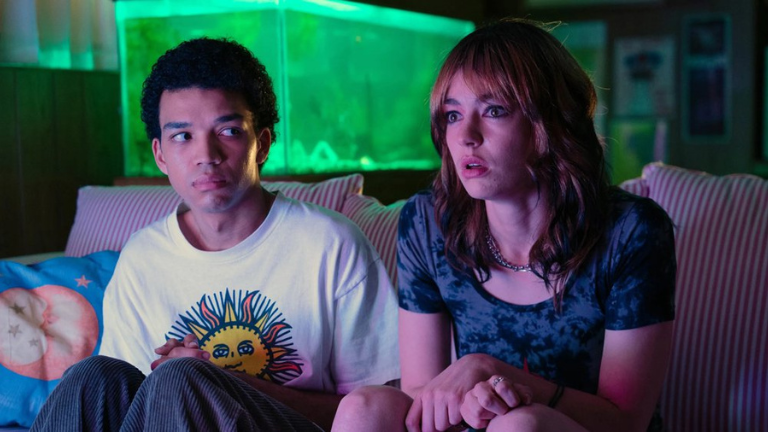
I Saw the TV Glow follows teenage Owen (Justice Smith) who meets Maddy (Jack Haven), a girl at his high school who is obsessed with the Snick-esque TV series, The Pink Opaque. Curious to learn more, Owen pretends to stay the night at his friends house that Friday night in order to sneak over to Maddy’s house and watch an episode of the show for himself.
The Pink Opaque centers around a summer camp where Isabel (Helena Howard) meets her imaginary friend Tara (Lindsay Jordan) and weekly they battle a monster-of-the-week in their overarching fight against the man in the moon, Mr. Melancholy. Complete with that fuzzy VHS look and 4:3 aspect ratio, it’s Are You Afraid of the Dark? meets Buffy the Vampire Slayer if it was directed by David Lynch.
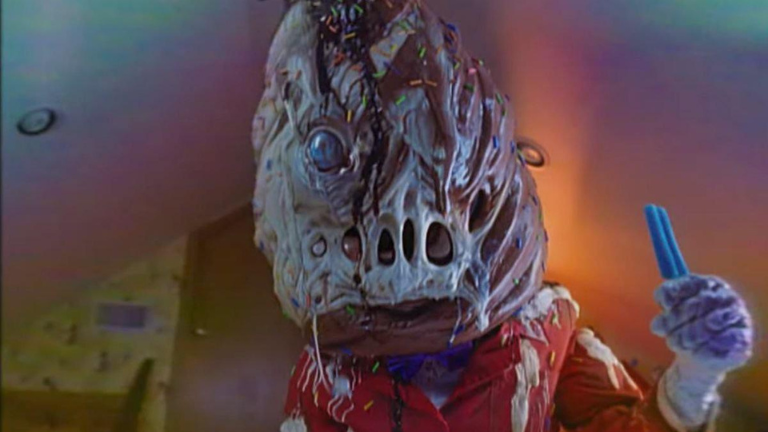
Soon, Maddy’s obsession with The Pink Opaque also becomes Owen’s and the two of them bond over their love of the show. But things start to get difficult when Maddy begins to question her own reality, becoming so involved with The Pink Opaque that she begins to believe that it might be her world that is fake and the world of The Pink Opaque that is the real world.
The implications of such a revelation play on a couple of themes. One, I think that there is a real discussion happening here about Millennials and our relationship to the media that raised us. So many of us are full of references and quotes, plot lines and callbacks that oftentimes fandom becomes deeply engrained as part of our identity.
Whether it is the Latchkey Kid upbringing that so many of us Millennials experienced or the fact that TV and movies of our youth have become such a comforting salve, for better or for worse (the film claims worse) to the awful real world that we seem cursed to occupy, our reliance on media to help us make sense of the world — and ourselves — feels to be unique to Gen Y, the very generation of the characters in this movie and its director.

And then there is the theme of trans identity. Interestingly enough, Schoenbrun does not quite hammer this part of the film as explicitly as one would expect had they simply just heard about TV Glow. In fact, on initial viewing, it may be very tempting to see the visual language of TV Glow to be mostly ideas and not so much dissection and inspection of the trans expereince.
But what makes this film so clever is how layered it is and much like other great trans texts like The Matrix, it knows that one of the best ways to make something this personal feel universal is to layer it into something that speaks more fully to a wider experience.
Certainly Schoenbrun is examining gender identity and the illumination and suppression that can take place as that discovery of identity takes place. I’ve seen some critics and reviewers say that discovering one’s own gender identity is “the text” of the film but it really isn’t.
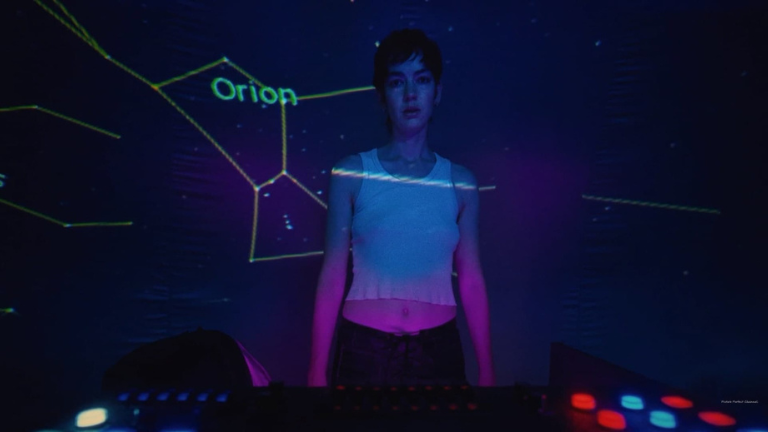
The text of I Saw the TV Glow is sometimes vague and more a tone poem of vicious suburban horror that speaks to the same internal scream of a trans youth struggling to understand who they are. It is that feeling of being so close to everyone else yet also feeling so distant and how that feeling is magnified as your personal identity becomes more and more separate from those around you.
In the case of I Saw the TV Glow, the identity goes beyond simply “I feel like I’m different” and becomes “I am different.” For these characters, their real selves are living within The Pink Opaque and in order for that self to be realized, the “fake” self needs to be buried. In some cases literally.

Here, you can feel the similarities to another of the great trans stories, The Matrix. The real you is not the one you believe that you are. The real you is elsewhere and needs to be unlocked. You can feel the artificiality of your fake self, and you must free the version of you that is the true self.
And that discovery of one’s “true self” that isn’t just a journey of the trans experience, but every single person must discover who they are in their own life. That’s the universality of I Saw the TV Glow. That’s the genius of how Schoenbrun wrote and directed this one. A fantastic film.
RATING: A




 Brandon Toks Movies
Leave a comment